
Searching Cochise County Criminal Dockets
The free Arizona Public Access case search covers most Arizona courts. It makes a broad first stop. Remember, though, that it is an informational index rather than the official record. Pick Cochise County Superior for a felony. For a misdemeanor, DUI, or state traffic case, pick the right one among the Bisbee, Douglas, Benson, Willcox, Sierra Vista, and Bowie Justice Courts. City charges go to the named municipal court instead.
No case number? Search by party name. Last Name or Business Name is required, and first name, middle name, filing year, and court can narrow what comes back. Case-number mode takes the format the court prints, and criminal numbers commonly start with CR. Complete the CAPTCHA, and if pressing Enter fails, the portal advises clicking Submit.
- Identify the court from the citation, complaint, notice, or prior minute entry.
- Select party-name or case-number mode, then narrow by court and year.
- Compare the case number, court, type, filing date, and status before opening a result.
- Read Case Events from oldest to newest, then check the most recent setting and count-level disposition.
- For official or missing information, contact that court's clerk and request the needed entry or document.
Inside a Cochise County Criminal Docket
Start at the header. It names the court, the criminal case number, the filing date, and the case type. The current status appears there too. Party fields show who prosecutes and who stands accused, subject to filters protecting confidential data. In the charge block you may find separate counts. Each carries an offense description, a statute or class when supplied, and its own disposition. The event list then ties filings and hearings to dates.
| Case Number | A court identifier, commonly using a CR prefix plus year and sequence. |
|---|---|
| Charges | Count number, offense description, classification, and the outcome recorded for that count. |
| Case Events | Dated complaints, motions, minute entries, notices, orders, pleas, trial events, and appeal activity. |
| Release | Bond type or amount, release conditions, changes, forfeiture, or exoneration when recorded. |
| Settings | Hearing date, time, type, and judicial officer drawn from the newest notice or minute entry. |
| Disposition | Pending, dismissed, convicted, acquitted, remanded, appealed, or another exact court term. |
A docket label only shows that an event was entered. It never replaces the filed order itself. When exact language matters, pull the image through eAccess or request the document from the Cochise County Clerk of the Superior Court.
Cochise County Criminal Docket Dispositions
Read each count on its own terms. One charge may be dismissed while another ends in a plea or trial disposition. A bond entry is not the outcome, and an arraignment plea is not a sentence. An early complaint merely describes an accusation at that stage. It cannot establish what the court later decided.
- Pending
- The charge or case has no recorded final outcome yet.
- Dismissed
- The court ended the stated charge or claim, subject to the exact qualifying words.
- No contest
- A plea made without contest and handled by the court under Arizona law.
- Disposition
- The outcome recorded for a charge or case, which must be read at the proper level.
- Remanded
- The matter was sent back or transferred as the entry states.
Multi-count dockets need side-by-side reading. Compare the disposition beside every count in a Cochise County criminal docket against the later judgment or sentencing event. That habit keeps the chronology honest instead of collapsing it into one misleading status word.
How a Criminal Case Moves
A criminal case grows through filings and court action. After the initial appearance settles rights and release, a felony may move through preliminary review, charging by indictment or information, and arraignment. Disclosure, motions, conferences, and reset notices can follow. A change of plea or a trial then produces the later disposition and sentencing entries. Post-conviction or appeal events can extend the record further.
For the current date, the newest event matters most. An old pretrial setting lingers in the chronology after a continuance, until a later minute entry marks it continued, reset, vacated, or held. Vacated means pulled from the calendar; it does not by itself mean the case was dismissed. The Cochise County court dates page lays out the full setting-confirmation chain.
Note: A filed motion shows only a request. The later order shows whether the court granted, denied, or otherwise resolved it.
Cochise County Criminal Docket Images
Public Access gives you index fields and nothing more. Arizona eAccess adds a deeper layer. It offers eligible Superior Court criminal document images filed on or after July 1, 2010. An account is required, and documents cost money per item or through a recurring plan. Electronic certification carries an added fee. Do not confuse eAccess with eFileAZ; one serves public document access while the other receives filings.
The official eAccess page shows that separate document layer in detail.
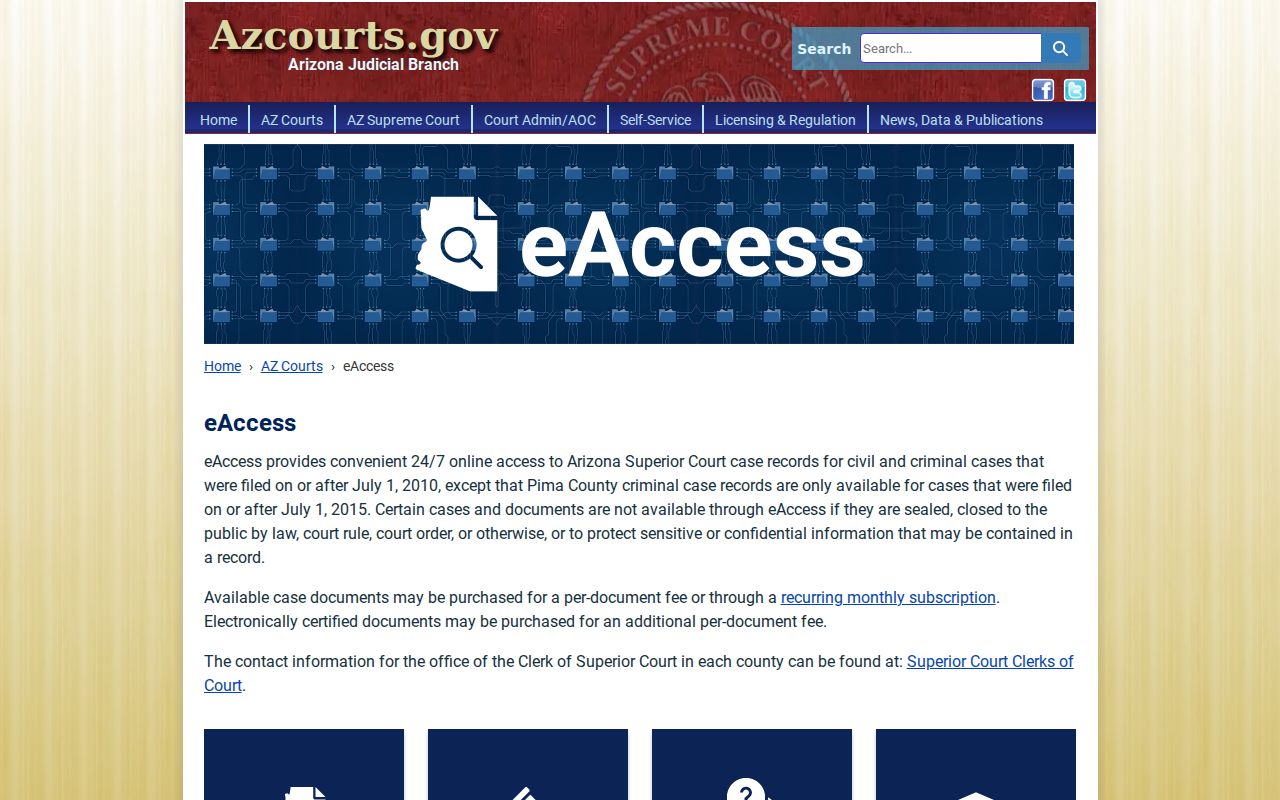
That document layer matters. It explains why a case-events list and the actual filed document deserve different treatment.
An image may not be eligible. It may simply be unavailable. In that case, call the Cochise County Superior Court Research Office at 520-432-8635. Requesters can also send the official form several ways. Email it to CochiseCountyResearch@courts.az.gov. Mail it to P.O. Box CK, Bisbee, AZ 85603, or deliver it in person at the Bisbee or Sierra Vista Clerk counter. Public computers at those locations offer another documented fallback. Justice and municipal files must go through their own clerks.
Courtroom audio moves through a separate Cochise County request channel. A digital recording is not automatically a certified transcript. The official transcript comes from the court reporter who attended the proceeding.
Courts That Hold Criminal Dockets
Felony files live with the Cochise County Clerk of the Superior Court. Visit the Bisbee office at 100 Quality Hill Road. Or use the Sierra Vista counter at 100 Colonia de Salud, Suite 200. A separate research office handles questions about old, unclear, missing, or excluded Superior Court records. Not every criminal file filed within county boundaries sits in these offices automatically.
Six Justice Court clerks hold limited-jurisdiction criminal dockets. They resolve state misdemeanors, DUI matters, and similar cases, while their felony work stays preliminary. Municipal clerks hold city-issued cases instead. The statewide dropdown separates Justice and Municipal entries for Benson, Bisbee, Douglas, Sierra Vista, and Willcox. Bowie Justice and other participating city courts appear too.
| Case path | Likely custodian | Best first check |
|---|---|---|
| Felony after transfer | Superior Court clerk | Cochise County Superior in Public Access |
| State misdemeanor or DUI | Named Justice Court clerk | Exact Justice Court in Public Access |
| City ordinance or city misdemeanor | Named municipal clerk | Municipal court directly |
Missing Cochise County Criminal Docket Cases
A blank result on a Cochise County criminal docket search does not mean no case exists. It may simply be hiding behind a misspelled name, the wrong court, or the wrong year. Some matters fall outside the system entirely. The statewide platform covers 177 of 184 Arizona courts and refreshes weekly. It leaves out local ordinance charges. A publication lag or an old paper file can also explain the gap. Try every reasonable spelling of the name, then confirm which court actually issued the case.
Each court type needs a different follow-up. Call the city court for a municipal matter. Contact the exact precinct for a Justice Court case. For Superior Court, use the Clerk's research request form or the two public terminals at the courthouse. Friday publication only reflects information through Wednesday. Confirm current settings with the court of record.
Sealed Dockets and Public Access
Arizona Supreme Court Rule 123 governs access to judicial records. Remote access is narrower than access at a courthouse. A court order or rule can restrict a file. Some categories never appear in the free statewide search. These include sealed cases, protection orders, mental-health and probate matters, victim and witness data, and juvenile delinquency information.
The juvenile-record statute shows one key limit on Cochise County criminal docket access:
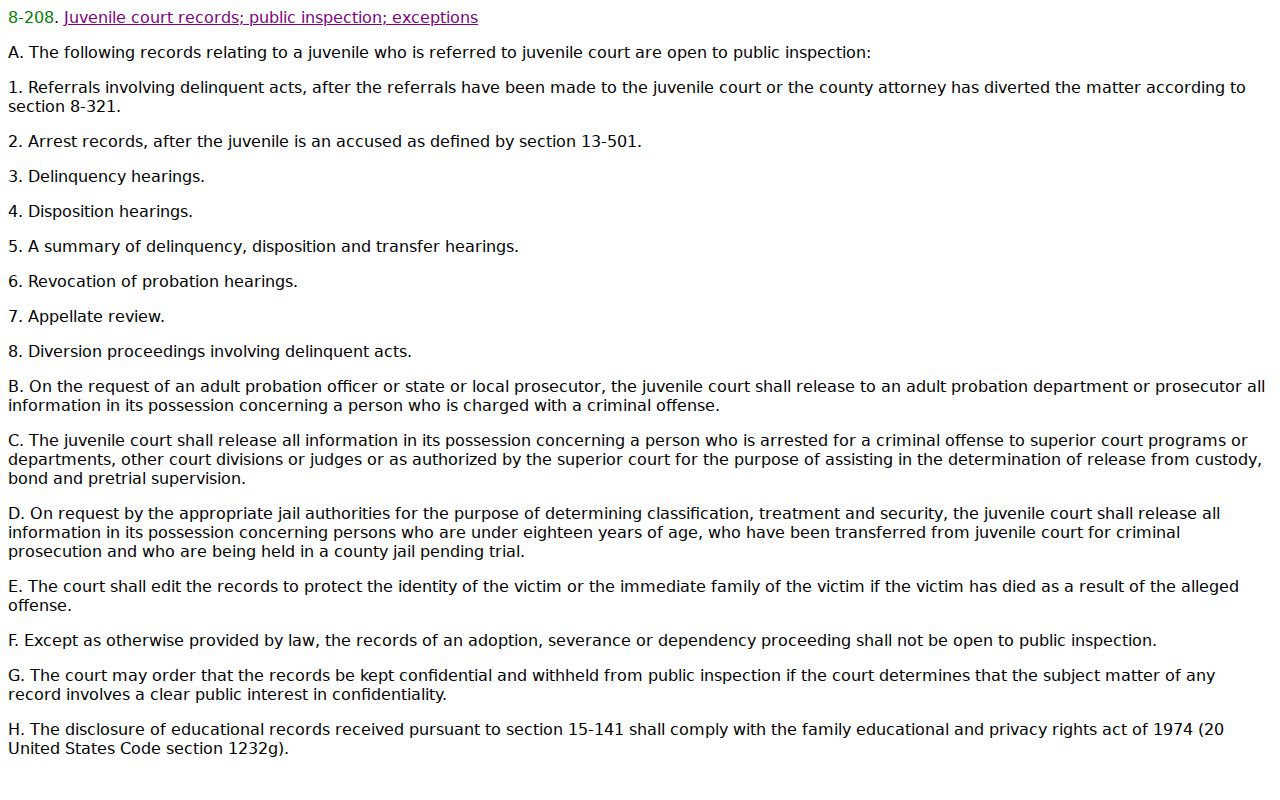
That statute ties the portal's lack of delinquency data to a defined access rule. It is not a search failure.
Access rules: A public index result is not a certified court record. Restricted access cannot be bypassed through another portal, and the clerk cannot override a judicial restriction.
A person authorized to seek a restricted file should contact the court, establish identity or authority, and follow the court's order-based process.
Cochise County Criminal Docket Sealing
Arizona offers an official sealing process. People can petition to seal eligible criminal case records. You file the petition in the court that handled the case. Governing law and the court's own order control both eligibility and effect. Keep two cautions in mind. Filing a petition does not by itself cut off public access. No fee amount appears in the official sealing material. Assume nothing about cost. The Arizona criminal-record sealing resource shows the official forms and process:
A sealing request belongs on the court-run path. A filed petition is not the same as an entered sealing order. Once a Cochise County criminal docket is restricted, Public Access may suppress the case or selected events. EAccess may withhold documents. Work with the clerk of the court that entered the restriction if you are an authorized party. For any public docket, verify the current case status. Check each count's disposition with the originating court.